
A question-and-answer guide from GBP Direct
When planning an office, one of the most common questions businesses face is whether they should choose sit-stand desks or traditional fixed-height desks.
The answer isn’t necessarily one or the other. Different employees, departments, jobs, and work environments have different needs. In many offices, the best solution may actually be a combination of both.
Here are some of the most common questions businesses ask when choosing between sit-stand and traditional office desks.
What is a sit-stand desk?
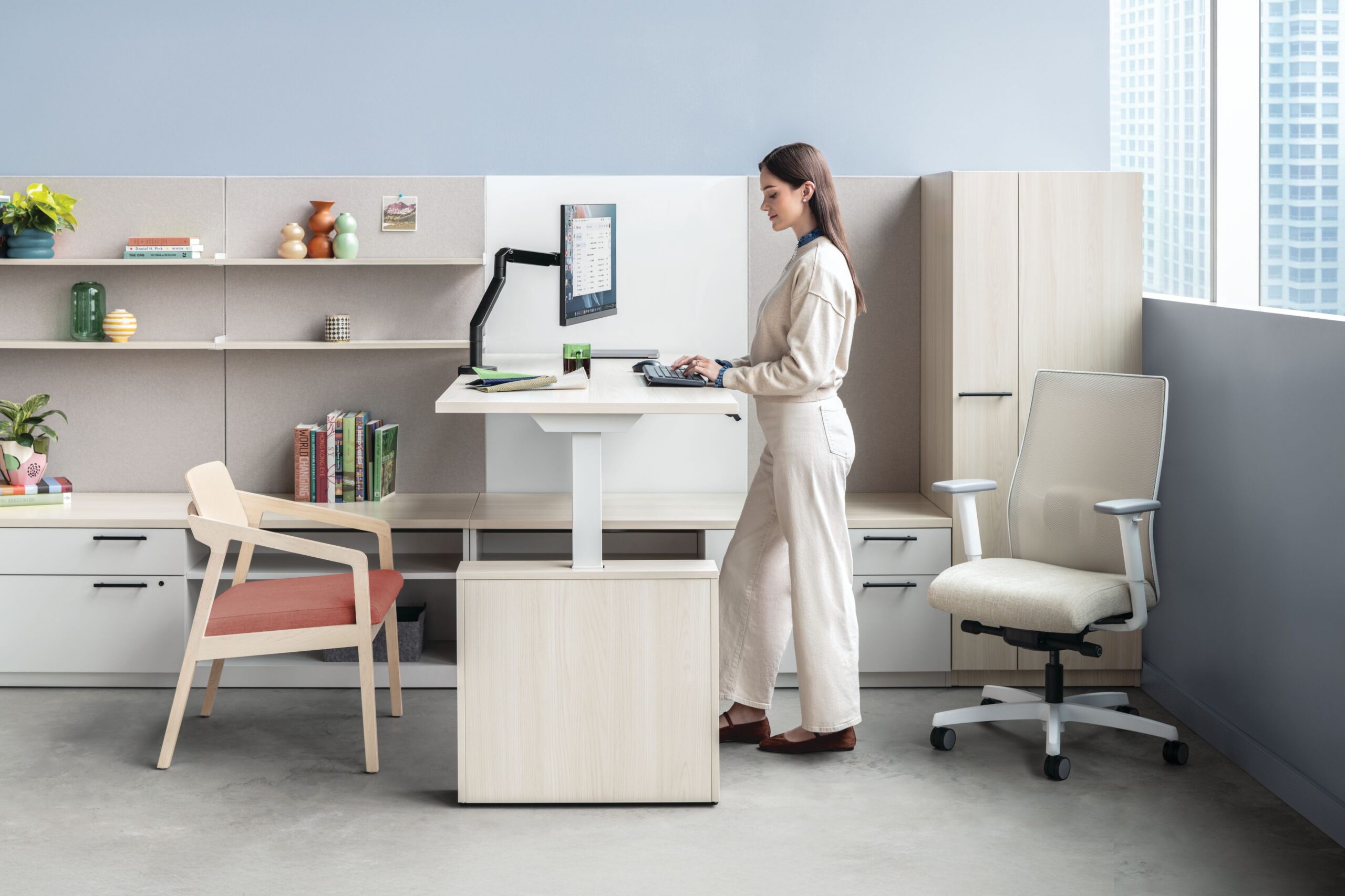
A sit-stand desk, sometimes called a height-adjustable desk, allows the user to raise or lower the work surface so they can work either sitting or standing. Many modern models are electrically adjustable, allowing employees to change positions with the push of a button.
The goal isn’t necessarily to stand all day. Instead, a sit-stand workstation gives employees the flexibility to change positions throughout the workday.
What are the benefits of a sit-stand desk?
The biggest advantage is flexibility. A sit-stand desk allows an employee to alternate between sitting and standing rather than remaining in one position for extended periods.
Potential benefits include:
- More flexibility throughout the workday
- The ability to change working positions easily
- Greater workstation adjustability for different employees
- Improved ergonomic customization
- A modern, adaptable workplace environment
- Better accommodation for employees with different physical preferences or requirements
For employees who spend most of their day at a computer, being able to adjust the height of the workstation can be particularly useful.
Does a sit-stand desk mean employees should stand all day?
No. A sit-stand desk is designed to provide choice, not require employees to stand continuously.
The concept is to allow workers to alternate between sitting and standing as appropriate. For example, an employee might sit while concentrating on detailed computer work, raise the desk for a phone call or meeting, and lower it again when they prefer to sit. The important advantage is having the ability to change positions.
Are traditional desks still a good choice?
Absolutely. Traditional fixed-height desks remain an excellent solution for many office environments. They can be particularly appropriate when:
- Employees primarily prefer sitting while working
- Workstations have standardized layouts
- Budget considerations are important
- The office has a large number of identical workstations
- Employees don’t need frequent height adjustment
- The workstation is used for tasks that don’t require changing positions
A well-designed traditional workstation can still provide an effective and comfortable working environment.
Which is more ergonomic: a sit-stand desk or a traditional desk?
There isn’t a universal answer. Ergonomics depends on the entire workstation—not simply the type of desk. The desk needs to work properly with the employee’s chair, monitor, keyboard, mouse, and other equipment.
For a sit-stand workstation, proper adjustment is particularly important because the desk should be positioned appropriately when the employee is both sitting and standing. A traditional desk can also be highly ergonomic when the desk height, chair, monitor, and accessories are properly configured for the employee.
Are sit-stand desks good for every employee?
Not necessarily. Some employees may benefit greatly from having the ability to change positions, while others may prefer a traditional workstation. The type of work being performed also matters.
The right question isn’t simply: “Are sit-stand desks better?”
The better question is: “What type of workstation is best for this employee and this job?”
Where do traditional desks make the most sense?
Traditional desks can work particularly well in:
- Administrative offices
- Reception areas
- Private offices
- Conference and meeting rooms
- Training rooms
- Shared workspaces
- Offices with standardized workstation layouts
- Applications where height adjustment isn’t necessary
Where do sit-stand desks make the most sense?
Sit-stand desks can be particularly useful for:
- Employees who spend most of their day at a computer
- Individual offices
- Open-plan workstations
- Executive and management offices
- Home-office environments
- Employees who prefer changing positions throughout the day
- Workstations where ergonomic adjustability is a priority
Does every workstation in an office need to be the same?
No. One of the biggest mistakes businesses can make is assuming every employee needs exactly the same workstation. An accounting employee, receptionist, sales representative, engineer, executive, and graphic designer may all interact with their workstations differently.
A well-planned office can incorporate different workstation configurations based on the work being performed:
- Sit-stand workstations for employees who spend most of their day at computers.
- Traditional desks for employees whose work doesn’t require frequent workstation adjustment.
- Conference tables for collaborative work.
- Private-office furniture for executives and managers.
- Height-adjustable or specialized work surfaces for employees with unique ergonomic requirements.
Are sit-stand desks more expensive than traditional desks?
Generally, height-adjustable desks can have a higher initial purchase price than comparable fixed-height desks because they contain additional components and adjustment mechanisms.
However, the purchase decision shouldn’t be based solely on the price of the desk. Businesses should consider the entire workstation, including the desk, chair, monitor arms, accessories, installation, ergonomics, durability, warranty, and expected lifespan.
Can an office use both types of desks?
Yes—and in many cases, that may be the most practical approach.
| Office Application | Possible Workstation |
| Computer-intensive work | Sit-stand desk |
| Executive office | Sit-stand or traditional desk |
| Reception | Traditional or specialized workstation |
| Conference room | Traditional conference table |
| Administrative work | Traditional or sit-stand |
| Collaborative workspace | Flexible-height tables |
| Training room | Traditional or mobile tables |
What should a business consider before purchasing office desks?
Before ordering, businesses should consider several key factors:
- What type of work is being performed? Computer work, paperwork, meetings, and collaboration may require different solutions.
- How much time does the employee spend at the workstation? An employee spending eight hours a day at a desk has different needs than someone who uses it intermittently.
- Does the employee need height adjustment? Not everyone does.
- What is the office layout? Open offices, private suites, and call centers require different strategies.
- What is the company’s budget? Balance quality, functionality, ergonomics, and value.
- Will the office change in the future? Consider future growth, employee relocation, and reconfigurability.
So, which is better: a sit-stand desk or a traditional desk?
There isn’t one answer that applies to every workplace. A sit-stand desk provides flexibility and adjustability. A traditional desk provides simplicity, consistency, and can be an excellent solution for many applications.
At GBP Direct, we believe office furniture should be selected based on how people actually work—not simply what’s popular. Our team can help businesses evaluate their workspace, determine the appropriate workstation configurations, and create an office environment that combines functionality, ergonomics, aesthetics, and value.
Whether your project calls for sit-stand desks, traditional workstations, executive furniture, conference tables, or a combination of solutions, the right furniture plan starts with understanding how your people work.
GBP Direct — Office Furniture. Office Products. Workplace Solutions.
Serving businesses, schools, government organizations, and other institutions throughout Southeast Louisiana and beyond.